High-strength acids promise a quick glow. But does more acid mean better results? In an authored article for Beauty Business Days, Dr. Oscar Pereira, Founder & Formulator, CodeSkin, examines the growing use of high-strength chemical peel. at home and why the conversation needs to move beyond concentration.
A higher acid percentage can look impressive on a skincare label. But does 25 percent or 30 percent automatically mean a better chemical peel? Not necessarily. For salon professionals, they must determine if clients understand what they put on their skin and when they need guidance.
When a bigger number starts to look better
For consumers, the appeal is understandable. Social media, online retailers and aggressive marketing have made high-strength skincare products increasingly accessible. A chemical peel containing 25 percent or 30 percent acids can therefore appear more powerful — and more effective.
But concentration alone does not determine how a peel performs.
According to Pereira, factors such as pH, the condition of the skin, exposure time, application technique and post-treatment care all influence the outcome. We can assess and manage these variables more effectively in a professional setting.
That distinction matters when treatments traditionally associated with professional care become readily available for home use.
A peel is more than an acid percentage
The percentage printed on a product is only one part of the formulation.
Chemical peels containing AHA, BHA, or PHA interact with the skin depending on their formulation and use. A strong product applied to skin that is already compromised, left on for too long or followed by inadequate aftercare can produce a very different result from the one promised by its marketing.
This is where professional knowledge becomes important.
A trained skin professional can consider the condition of the client’s skin and the appropriate treatment approach. At home, consumers may not have the same understanding of these variables.
The glow may not tell the whole story
The concern with excessively strong chemical peels is not limited to immediate irritation.
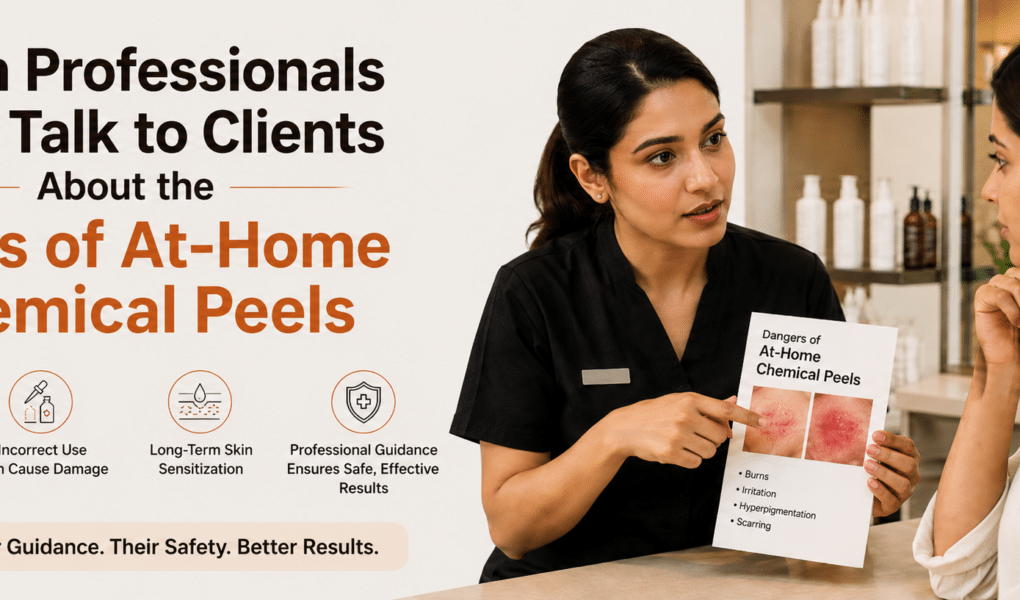
Pereira highlights irritation, inflammation, sensitivity and post-inflammatory hyper-pigmentation among the potential consequences of compromising the skin’s natural protective function.
Importantly, the effects may not always appear straight away.
A client may initially notice smoother or brighter-looking skin and assume the product has delivered the desired result. Problems can emerge later, after the initial glow has faded.
For salon professionals, this makes it important to understand what clients are using at home, particularly when they present with unexplained sensitivity or pigmentation.
What should professionals ask?
The answer is not necessarily to discourage clients from using active skincare. It is to encourage informed use.
What product are you using? What is the acid concentration? How often are you applying it? And how long are you leaving it on? How does your skin respond afterwards?
These questions can help reveal whether a client understands the product or is simply following an online recommendation.
Pereira believes salon professionals have an important educational role here. Clients often trust their therapists and skin specialists more than advertising claims. That trust can help professionals explain the difference between a professional chemical peel and unsupervised experimentation.
Where should high-strength peels be used?
Pereira notes that products exceeding approximately 10% active acid concentration should generally remain within the domain of professional care, where practitioners understand how to manage both efficacy and safety.
The point is not that chemical peels are inherently unsafe. They remain effective skincare tools when appropriately selected and used.
The concern is the assumption that a higher concentration automatically means a better outcome.
For professionals, explaining this distinction can help clients make more informed choices rather than simply choosing the highest percentage available.
The responsibility extends to brands
The conversation around at-home chemical peels also raises questions for brands and formulators.
The beauty industry depends on innovation, and consumers increasingly seek products that promise faster and more visible results. But, as Pereira argues, innovation must also be guided by science, ethics and consumer welfare.
When the distinction between professional-grade treatments and retail products becomes unclear, the issue is not simply product safety. It can also affect consumer confidence.
For brands, trust remains a valuable asset. Clear communication about how, where and by whom a product should be used is therefore as important as the formulation itself.
Is stronger really better?
The growing interest in chemical peels reflects a wider consumer appetite for active skincare and visible results. The challenge begins when accessibility gets ahead of understanding.
A 30 percent acid formulation may look more impressive than a lower-strength product, but the more important questions are whether it is appropriate for the individual’s skin, how it should be used and whether professional supervision is required.
For salon professionals, this creates an opportunity to reinforce the value of expertise.
A chemical peel is more than the percentage printed on its label. Its outcome depends on the formulation, the skin condition, application, exposure time and aftercare.
As Pereira argues, true innovation in beauty does not come simply from increasing intensity. It comes from increasing understanding.
For an industry built on trust, that may be the more important conversation to have.