


During his recent visit to the ABC Academy powered by Kryolan in Khar, Mumbai, Gregor Knape, International SFX artist spoke Exclusively with Priyanka Parshurami. About what goes into creating convincing SFX, where creativity meets technical reality, why precision matters, how AI is influencing the field and what aspiring artists should understand before choosing SFX as a career.
What does it take to make something unreal look real? For Gregor Knape, International Special Make-Up Effects Designer for Kryolan, the answer begins long before the makeup reaches the face. It lies in understanding materials, studying reality, respecting technical limitations and knowing precisely what an image needs to communicate.
Knape has spent 28 years in the Special Make-Up Effects field, building expertise across film, theatre, opera and musical productions. His work has included projects and collaborations involving Paramount, Cirque du Soleil, Warner, Netflix and Amazon Prime, alongside productions across Europe.
Yet his professional journey began with something far less structured: a childhood fascination with monsters, creatures and the question of how they could be brought to life.
From a Fascination With Monsters to SFX
Knape’s interest in Special Make-Up Effects began during childhood.
He recalls being fascinated by classic Dracula and werewolf films. The creatures frightened him, but they also captured his imagination. He began drawing skeletons and other creatures, long before considering that such an interest could become a profession.
The turning point came when he watched a behind-the-scenes documentary on how the film’s creatures were physically created through SFX.
At the time, Knape was studying English language and theatrical sciences. He eventually decided that he wanted a more practical career and applied to a makeup school in Germany.
When asked during an interview what interested him most, his answer was simple: he wanted to make monsters.
That eventually led him to a specialist private school in Berlin, where he began his education in 1998.
What Makes an SFX Look Convincing?
For Knape, there is no single formula for creating a convincing SFX look.
Special Make-Up Effects encompasses a wide range of disciplines, and the approach depends on what the artist is trying to communicate.
Creature design, horror and fantasy allow greater creative freedom because the audience already understands that the subject is fictional. Realistic injuries present a different challenge.
When creating wounds or Creature, Knape believes artists need to understand reality before attempting to reproduce it.
Studying real images and footage can help artists understand how actual injuries look because people have a shared visual understanding of danger and trauma.
But recreating reality for the screen introduces another problem: an effect has to appear realistic while also being visible to the audience.
A real injury can be subtle. A cinematic wound needs to communicate what has happened.
For an SFX artist, that balance between realism and visual storytelling becomes part of the craft.
Precision Is at the Heart of the Craft
Asked which SFX technique requires the most skill and precision, Knape does not name one universal answer.
The field contains multiple specialist disciplines, including mould making, application and colourisation. At advanced levels, some areas become almost engineering disciplines.
However, when working directly on a person, Knape considers hair application particularly unforgiving.
Creating a beard, for example, can involve layering individual hairs directly onto the skin with adhesive. Unlike workshop work, where an artist can take time to correct an imperfection, work at the makeup chair happens against a production clock.
There is a person sitting in front of the artist, the adhesive is already involved and every layer has to be placed accurately.
For Knape, that makes precision fundamental to the process.
Creativity Does Not Always Start With the Artist
One of Knape’s more unconventional observations is that SFX artists working on major film and television productions are not necessarily creating the original visual concept.
A director may have a vision, while production and costume designers contribute their own visual language. The SFX artist’s responsibility is often to interpret that vision and determine how it can be executed.
That requires a particular kind of creativity: adapting rather than simply inventing.
When artists work on their own projects, however, Knape encourages them to experiment beyond their current capabilities.
He suggests beginning ambitious projects without being afraid of reaching a point where the artist realises that something cannot yet be achieved technically.
That limitation can become part of the learning process.
When AI Creates Unrealistic Expectations
Artificial intelligence has added another challenge to the SFX process.
AI-generated images can create visual concepts that appear convincing but may not be physically possible to reproduce.
Knape says this can be particularly complicated when younger artists or clients assume that anything visible in an AI-generated image can be recreated practically.
Sometimes achieving such an effect would require extensive post-production. In other cases, the concept may simply not be physically possible.
For Knape, this makes technical understanding increasingly important. Creativity has to operate alongside knowledge of materials, equipment and physical limitations.
At the same time, he does not believe technical limitations should prevent artists from experimenting.
Trying something ambitious, even if it cannot immediately be completed, can help keep the creative process active.
Bringing Technical SFX Training to ABC Academy
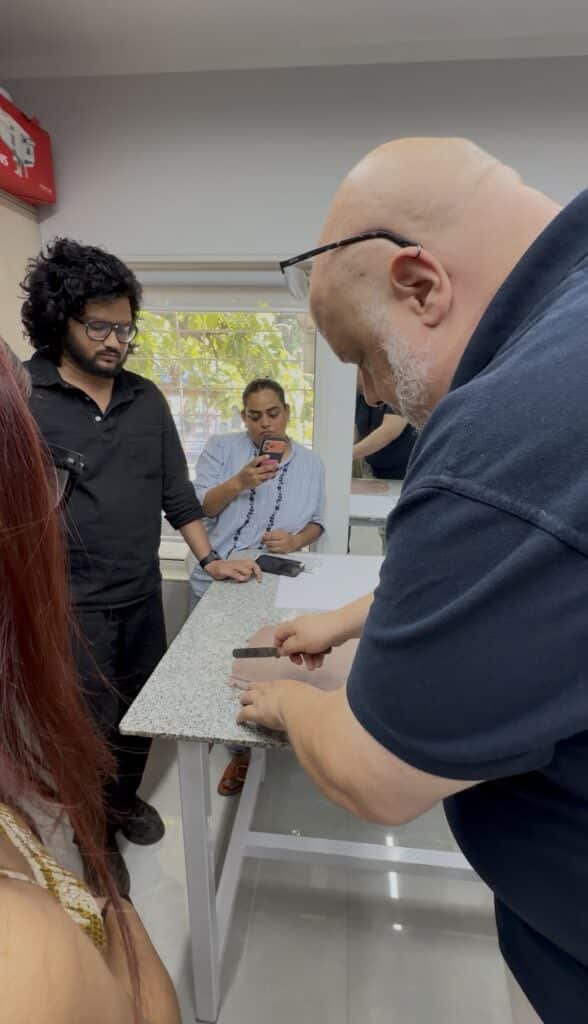
At the ABC Academy powered by Kryolan in Khar, Knape is sharing this technical approach with students through a Special Effects course focused on three-dimensional creation and mould making.
He was particularly positive about the Academy’s facilities, noting that this kind of SFX training requires equipment that goes beyond what is traditionally associated with makeup.
His own professional work at Kryolan includes a strong focus on material chemistry and application, product development and training makeup artists and sales personnel. Sculpting also remains one of his areas of interest.
His approach to teaching reflects the same principle that informs his professional work: understanding the material and the process is as important as having the creative idea.
Should Aspiring Artists Specialise Only in SFX?
For anyone considering SFX as a career, Knape offers a practical perspective.
The film and television industry requires a large volume of conventional makeup work, while specialised SFX represents a smaller proportion of the overall market.
For this reason, specialising exclusively in three-dimensional creature creation or casualty effects can carry financial risk.
His advice is to develop a broad portfolio of capabilities.
An SFX qualification can add a specialisation and help an artist stand out, but maintaining strong standard makeup skills can provide greater professional flexibility.
For emerging artists, therefore, SFX can be an important part of their skill set without necessarily becoming their only skill.
The Discipline Behind Making the Unreal Real
After nearly three decades in SFX, Knape’s approach comes down to a combination of imagination and technical understanding.
The artist needs imagination to conceive the effect. But materials, anatomy, precision, equipment, timing and physics determine whether that idea can actually exist.
That is what makes SFX different from simply creating something visually impressive.
The audience has to believe what it sees.
And when asked during a rapid-fire conversation what makes a great SFX makeup look, Knape’s answer was succinct: it has to look real.
After 28 years of working to make the unreal tangible, that remains perhaps the simplest measure of the craft.

